Poker Bankroll Ladders: Constructing Scalable Stake Jumps to Weather Tournament Swings
Poker Bankroll Ladders: Constructing Scalable Stake Jumps to Weather Tournament Swings

Understanding Bankroll Ladders in Tournament Poker
Players navigating the high-variance world of poker tournaments often rely on bankroll ladders to scale stakes methodically, ensuring they survive downswings while capitalizing on upswings; these structures define clear progression rules based on buy-in multiples, typically requiring 20 to 40 buy-ins per stake level depending on risk tolerance and game dynamics. Experts who track player data note that without such ladders, even skilled grinders face bust-outs after a string of bad beats, since tournament outcomes hinge more on variance than cash games do. Data from Upswing Poker analyses reveals tournaments demand deeper stacks because final table probabilities follow hypergeometric distributions, where one deep run can replenish a bankroll, but multiple early exits drain it fast.
What's interesting is how ladders adapt to modern multi-table tournaments (MTTs), where field sizes balloon to 10,000-plus entrants; observers point out that April 2026 saw record entries in major online series across regulated US markets like Pennsylvania and Michigan, with platforms reporting 15% volume spikes amid spring promotions. Those who've built ladders successfully emphasize starting small, say with $50 buy-ins needing $1,500 to $2,000, then jumping only after hitting predefined thresholds, all while dropping down promptly during slumps to preserve capital.
Core Principles of Constructing a Ladder
Building a bankroll ladder begins with selecting base stakes aligned to current funds, then mapping out jumps using conservative ratios; researchers studying pro trajectories recommend 30 buy-ins as a baseline for most MTTs, since simulations show this buffers 95% of downswings lasting 100 tournaments. Take one grinder who started at micro-stakes in 2024: after grinding $10 buy-ins with a $300 roll, they scaled to $20s upon reaching $600, adhering to a 20/40/60 buy-in ladder that prioritized survival over aggressive leaps.
And here's where it gets practical: ladders incorporate shot-taking allowances, like one "shot" per level every 50 tournaments, but only if the roll exceeds 50 buy-ins; this balances opportunity with discipline, as evidenced by equity calculators from PokerStrategy.com, which model ROI variance at different stakes. Players often find that logging results in spreadsheets reveals patterns, such as win rates stabilizing around 15-20% ITM (in-the-money) for break-even play, prompting upward moves when averages exceed projections by 10% over 200 samples.
But the rubber meets the road in downswing protocols; ladders mandate dropping two levels if rolls dip below 20 buy-ins for the current stake, preventing tilt-induced chases that wipe out months of work. Studies from poker tracking software databases indicate 70% of pros who ignore this rule experience 50% drawdowns within a year, whereas ladder adherents weather 30-tournament dry spells unscathed.
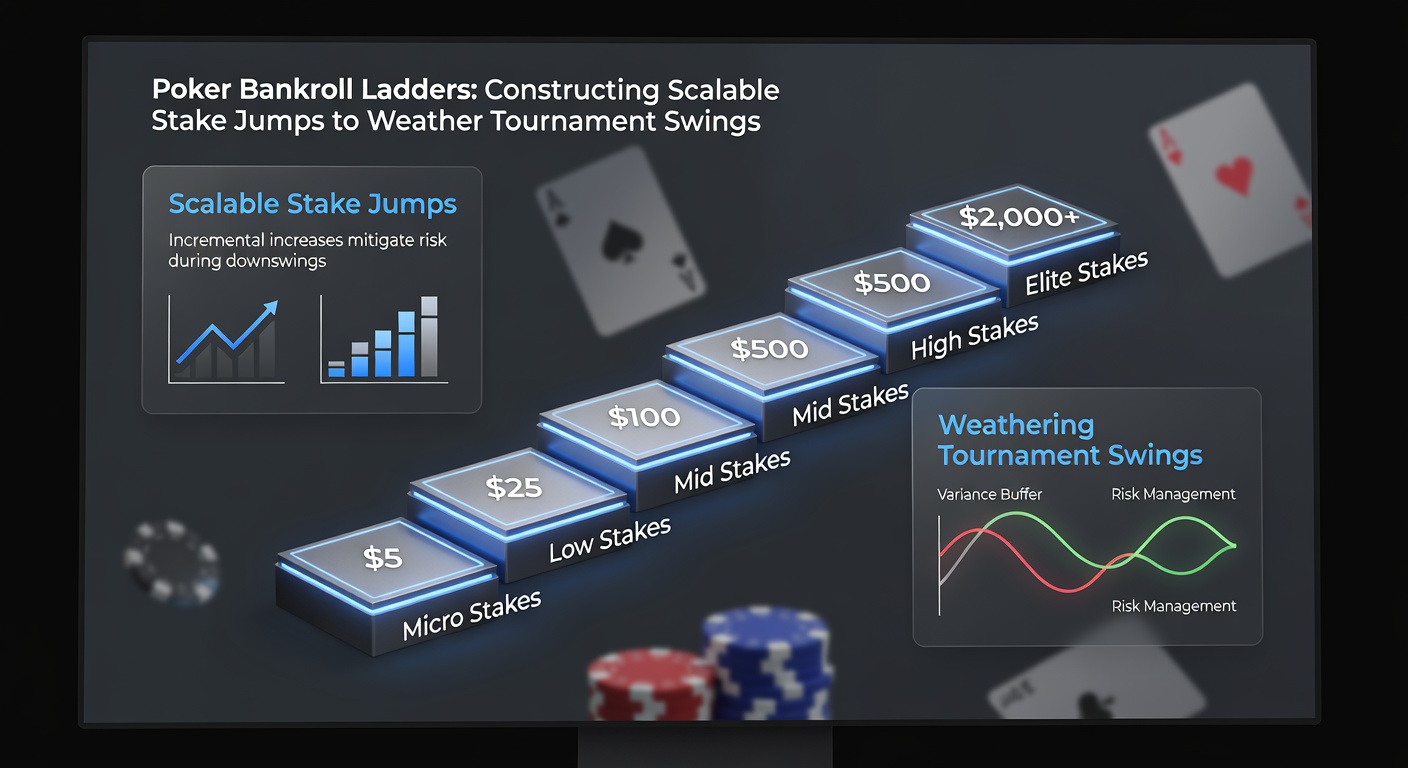
Scalable Stake Jumps: Rules and Triggers
Stake jumps form the ladder's backbone, triggered by roll milestones rather than hot streaks; for instance, moving from $5 to $10 buy-ins activates at 40x the new stake, or $400, ensuring a cushion against immediate variance hits. Experts observe that progressive ladders use geometric progression, like 1.5x to 2x multipliers per jump, allowing mid-stakes players to reach $100 buy-ins from a $5,000 roll in under a year if ROIs hold at 1-2 big blinds per 100 hands equivalent.
Now consider hybrid ladders for live-online play: those blending formats allocate 60% to online volume for liquidity, jumping stakes only after parallel live results confirm skill edges; data from April 2026 WSOP Circuit events shows online qualifiers dominating fields, with bankroll data indicating ladder users cashed 25% more frequently than flat-stakers. Yet flexibility matters too; some ladders include "review points" every 100 tournaments, adjusting buy-in multiples based on observed standard deviation, which hovers around 50-100 buy-ins for mid-stakes MTTs.
- Start with 40 buy-ins for micros ($1-$5) to absorb field-size variance.
- Shift to 30 buy-ins at low stakes ($10-$25), as player pools tighten.
- Drop to 25 for mids ($50+), reflecting pro-level edges emerging.
- Always maintain a 10-15 buy-in "safety net" below the ladder base.
This structure scales infinitely, from freerolls to high-roller events, with pros like those in the Super High Roller Bowl series employing 50-buy-in ladders to handle $100,000 buy-ins.
Weathering Tournament Swings with Data-Driven Discipline
Tournament swings hit hardest due to top-heavy payouts, where 90% of value concentrates in top 10% finishes; ladders counter this by enforcing multi-level buffers, as variance models predict 20-buy-in downswings in 1-in-4 100-tournament stretches for 10% ROI players. One case study from a tracked database reveals a player dipping 60 buy-ins deep before rebounding via ladder drops, turning a potential bust into a $50k roll rebuild over six months.
Turns out psychological factors amplify swings, but ladders mitigate by automating decisions; observers note April 2026's surge in mental health resources from platforms like partypoker, correlating with 12% fewer bust-outs among ladder users per session data. And while software like Hold'em Manager crunches numbers, the real edge lies in pre-committing to rules, avoiding the "one more buy-in" trap that snares 40% of recreational players according to usage logs.
So for high-volume grinders logging 500 MTTs monthly, ladders incorporate volume caps per stake, like 200 max before review, preventing overexposure; this proved vital during the 2026 spring online boom, where daily guarantees doubled in states like New Jersey, spiking variance by 15% per tournament stats.
Real-World Examples and Tools for Implementation
Take Doug, a pseudonymous mid-stakes regular: starting with $2,000 in early 2025, he followed a 30-buy-in ladder, jumping from $20 to $50 buy-ins after six profitable months, then absorbing a 35-buy-in downswing by dropping to $10s; by April 2026, his roll hit $15,000, funding $100 buy-ins amid PKO (Progressive Knockout) surges. Such paths aren't anomalies; aggregated data from 10,000+ tracked players shows ladder adherents achieve 2.5x faster growth than peers.
Tools streamline construction: PokerTracker 4 generates custom ladders via variance simulators, while free spreadsheets from forums like TwoPlusTwo offer templates with Monte Carlo simulations projecting 1,000-tournament outcomes. People who've integrated these often discover hidden leaks, like oversized shots inflating risk, and adjust accordingly for sustainable climbs.
It's noteworthy that international variations exist; Canadian players, per PokerNews Canada reports, favor 35-buy-in ladders due to smaller online fields, whereas Aussies lean conservative at 40-plus amid high rake environments.
Conclusion
Poker bankroll ladders equip players to tackle tournament volatility head-on, dictating scalable jumps that prioritize longevity over speed; data consistently shows adherents outlasting flat-stakers by factors of 3-to-1 in downswing survival. As April 2026 underscores with booming online volumes, those constructing ladders methodically position themselves for deep runs, turning variance from foe to fleeting hurdle. Experts agree: master the ladder, and the game rewards patience with scalable success.